

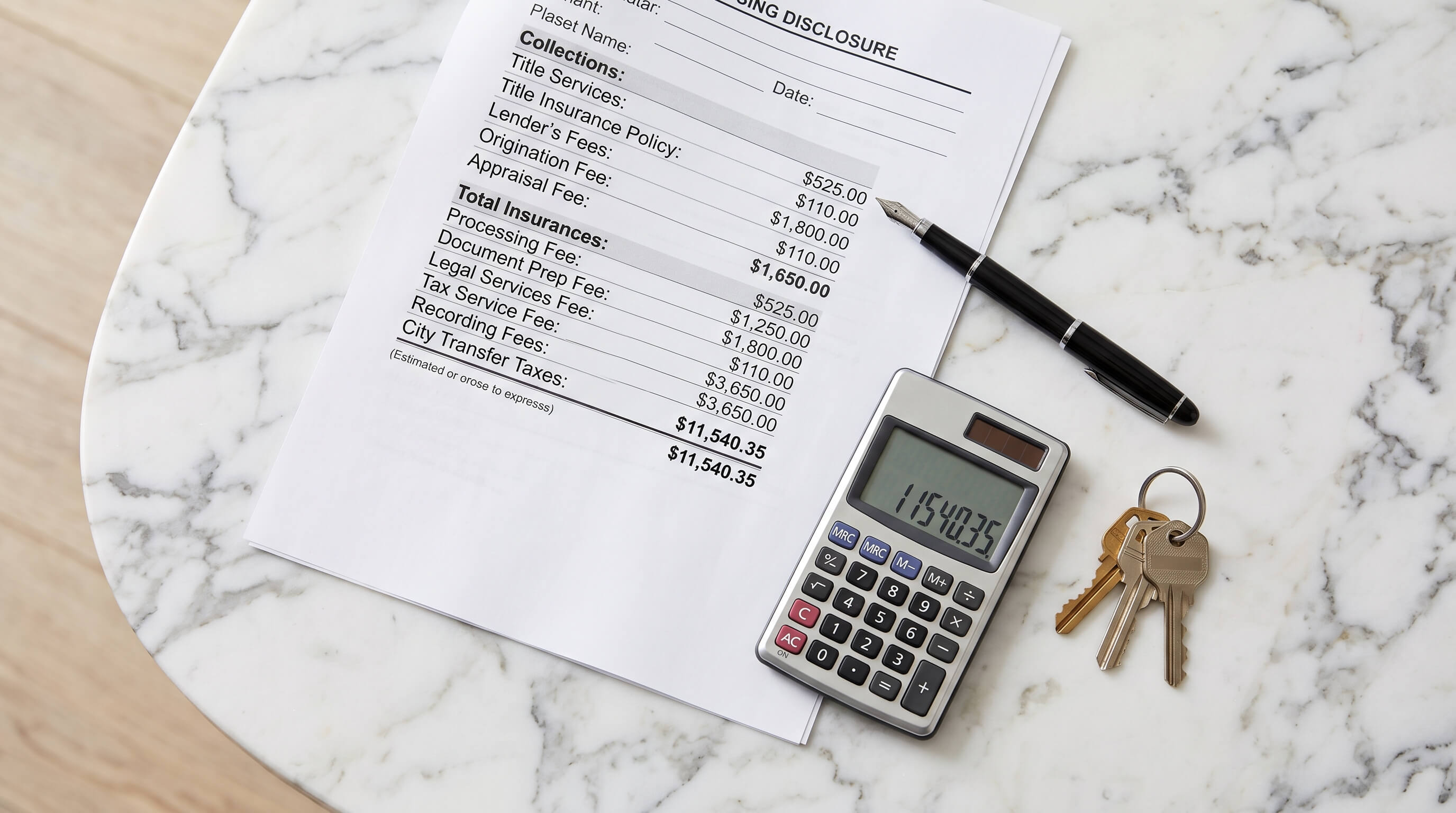
If you're wondering how much does it cost to sell a home in NYC, the answer is higher than most sellers expect. Plan for 8% to 10% of your sale price once you add up broker commissions, transfer taxes, attorney fees, flip taxes, and prep costs. On a $1M apartment, that's roughly $80K to $100K you won't see at closing.
The good news: most of these costs are predictable, and some are negotiable. This guide breaks down every cost you'll face selling in NYC in 2026, with real dollar examples at $500K, $1M, and $2M price points. You'll see what's changed with broker commissions, which costs hit co-op sellers differently than condo sellers, and where you can actually save.
Total Cost to Sell in NYC at a Glance
Here's every line item you should expect as an NYC seller, with ranges that reflect real 2026 market conditions.
Major Cost Categories
- Broker commission: ~4% total (~2% per side)
- NYC + NYS transfer taxes: 1.4% to 2.075% depending on sale price
- Attorney fees: $2,500 to $4,000
- Flip tax (co-ops only): 1% to 3% of sale price
- Pre-listing prep (staging, photos, repairs): $1,700 to $20,000+
- Capital gains tax: 0% to 38.6% depending on your situation
- Miscellaneous (move-out, managing agent, recording fees): $500 to $3,000
Quick Totals at Three Price Points
These percentages shift based on property type (co-op vs. condo), price point, and how well you negotiate. Co-op sellers almost always pay more because of flip taxes. Each section below explains what's fixed, what's flexible, and where the surprises hide.
Notice the pattern: condo sellers at $500K and $2M land between 6.5% and 7% in total costs. Co-op sellers at $1M cross 9% because of the flip tax. That single line item is why knowing your building's policy matters before you set an asking price.
One more thing these totals don't include: mortgage payoff and capital gains tax. Both vary by seller and can change your take-home number by tens of thousands of dollars.
Broker Commission in NYC: What Sellers Actually Pay in 2026
The national average broker commission is about 5.7%. NYC sellers usually pay less, around 4% total, but the structure is more complicated than it used to be.
How the Split Works
In the NYC metro area, the typical commission is roughly 2% to the listing agent and 2% to the buyer's agent, totaling about 4%. NYC commissions run lower than the national average because higher price points and transaction volume give agents enough revenue at lower percentages. A 2% commission on a $1.5M Brooklyn brownstone ($30,000) pays more than a 3% commission on a $400K suburban home ($12,000).
The NAR Settlement Effect
After the August 2024 NAR settlement, buyer-agent commissions are no longer published on the MLS. In theory, this was supposed to push buyer-agent fees down. In practice, Q1 2025 data showed buyer-agent commissions actually ticked up to 2.4%, from 2.37% in Q4 2024. No meaningful decline has materialized. Most sellers still offer buyer-agent compensation to attract the widest pool of offers.
The settlement did change one thing: transparency. Buyer-agent agreements now require written disclosure of the commission before showings. As a seller, you can use this to your advantage. If you see that most competing listings offer 2% to buyer's agents, matching that number keeps you competitive without overpaying.
What's Negotiable
Your listing agent's commission is always negotiable. If your property is high-value or easy to sell, you have leverage. Discount brokerages offering 1% listing fees exist, but they typically provide fewer marketing resources and less hands-on service. Ask potential agents what their commission includes. A full-service agent at 2% who provides professional photography, staging coordination, StreetEasy featured placement, and open house management delivers more value than a discount agent at 1% who lists your apartment and waits for calls.
Dollar Examples
- $500K sale: ~$20,000 in total commission
- $1M sale: ~$40,000
- $2M sale: ~$80,000

NYC Transfer Taxes and the Cliffs That Cost Sellers Thousands
Sell your NYC apartment for $500,000 and you'll pay $7,000 in transfer taxes. Sell it for $500,001 and you'll pay $9,125. That extra dollar just cost you $2,125.
Two Layers of Transfer Tax
- NYC Real Property Transfer Tax (RPTT): 1.0% on sales at or below $500K. 1.425% on sales above $500K. This rate applies to the entire sale price, not just the amount over $500K.
- NYS transfer tax: 0.4% on sales below $3M. 0.65% on sales at or above $3M.
Combined Rates
| Sale Price | Combined Rate | Example Tax ($1M sale) |
|---|---|---|
| Below $500K | 1.4% | — |
| $500K to $3M | 1.825% | $18,250 |
| $3M and above | 2.075% | — |
The $500K Cliff: A $2,125 Trap
Pricing at $500,001 instead of $499,999 costs you an extra $2,125 in transfer taxes — because the higher 1.425% rate applies to the entire sale price. You'd need to sell above ~$512K before the higher price offsets the tax jump.
The same dynamic applies at $3M. A buyer at $2,999,999 vs. $3,000,001 triggers a $7,500 jump in transfer taxes. Work with your agent to model exact break-even numbers before setting your list price.
Co-op Flip Tax: The Fee That Surprises NYC Sellers
You're selling your co-op. You've negotiated the commission and budgeted for transfer taxes. Then your managing agent tells you there's a flip tax. It's in your proprietary lease, and it's not negotiable.
What It Is
A flip tax is a fee charged by the co-op building when you sell your apartment. Despite the name, it's not a government tax. It's a building policy, and the money goes into the building's reserve fund. Typical range: 1% to 3% of the sale price.
Four Calculation Methods
- Percentage of sale price (most common): 1% to 3%. Simple and predictable. On a $1M sale with a 2% flip tax, you pay $20,000.
- Percentage of profit: Based on your gain over the original purchase price. If you bought at $800K and sell at $1M, a 20% profit-based flip tax costs $40,000.
- Flat fee per share: A fixed dollar amount multiplied by the number of shares allocated to your unit. Less common but still used in older buildings.
- Sliding scale based on years of ownership: The longer you've held, the less you pay. This method rewards long-term residents.
HDFC Co-ops Are a Different Story
Income-restricted HDFC buildings charge flip taxes of 10% to 30% of the sale price. On a $500K HDFC sale, that could mean $50,000 to $150,000 in flip tax alone. If you own in an HDFC, check your proprietary lease before you even think about listing.
HDFC flip taxes are intentionally high. They preserve affordability by discouraging owners from flipping for market-rate profits. If you bought an HDFC unit at a below-market price, the flip tax recaptures much of the appreciation for the building.
Attorney Fees and Other Required Closing Costs
These aren't the headline costs, but they add $3,000 to $7,000 to your closing bill. Most are non-negotiable.
The Full Closing Cost Breakdown
- Attorney fees: $2,500 to $4,000. New York State requires attorney representation at closing for both buyers and sellers. This isn't optional.
- Managing agent fees (co-ops): $500 to $1,000. The building's management company charges a processing fee for the sale.
- Move-out deposit and fees (co-ops and some condos): $500 to $2,500. Many buildings require a refundable deposit before you move out.
- UCC-3 filing (co-ops): $100 to $200. This releases the lien on your co-op shares after your loan is paid off.
- Stock transfer tax (co-ops): $0.05 per share. A small cost, usually a few hundred dollars.
- Deed recording fees (condos): $50 to $100.
- Mortgage payoff fees: $150 to $500. Your bank charges a processing fee to close out your mortgage.
Total miscellaneous closing costs typically land between $3,000 and $7,000 depending on whether you're selling a co-op or condo. Co-op sellers pay more because of managing agent fees, UCC-3 filings, and stock transfer taxes that condo sellers don't face.
NYC Mansion Tax: A Buyer Cost That Affects Your Sale Price
You don't pay mansion tax. Your buyer does. But it directly affects how much you can sell for and how quickly your listing moves.
What It Is
The mansion tax is an NYC surcharge on purchases of $1M or more. It has eight tiers, ranging from 1.0% on purchases between $1M and $2M up to 3.9% on purchases of $25M and above. The rates haven't changed since 2019. A proposed 2026 restructuring did not pass.
Key Tiers to Know
| Purchase Price | Mansion Tax Rate | Tax on That Amount |
|---|---|---|
| $1M to $2M | 1.0% | $10,000–$20,000 |
| $2M to $3M | 1.25% | $25,000–$37,500 |
| $3M to $5M | 1.5% | $45,000–$75,000 |
| $5M to $10M | 2.25% | $112,500–$225,000 |
| $10M+ | up to 3.9% | escalates |
The $1M Cliff: Price Below It and Outsell Competing Listings
A buyer at $999,999 pays $0 in mansion tax. At $1,000,000 they pay $10,000. Listings priced at $999K routinely attract more offers than identical apartments at $1.05M. The mansion tax cliff changes buyer psychology in ways that override the actual dollar amount.
Pricing strategy: Work with your agent to price just below cliff thresholds. $999K, $1.99M, and $2.99M are strategic price points in NYC for exactly this reason. The mansion tax doesn't come out of your pocket, but it shapes what buyers are willing to pay.

Pre-Listing Costs: Staging, Repairs, and Photography
Closing costs get all the attention, but you'll start spending money weeks before your apartment hits the market. These costs come out of pocket before you have a buyer.
Cost by Category
- Staging: $1,500 to $5,000. A professional staging company furnishes and styles your apartment for showings and photos. Virtual staging runs cheaper at $200 to $500, but it's less effective for higher-end properties. Empty apartments consistently sell for less and sit on the market longer.
- Photography and video: $200 to $500. Professional photos are non-negotiable in NYC's online-first market. 3D tours and Matterport scans cost an additional $300 to $800 and are increasingly expected for properties above $1M.
- Repairs and touch-ups: $0 to $15,000+. Fix anything a buyer will use to negotiate your price down. A $2,000 repair is cheaper than a $10,000 price reduction.
- Cleaning: $200 to $500. Budget for a deep clean before photography and again before showings begin. Kitchens and bathrooms matter most.

Co-op vs. Condo: How Seller Costs Differ in NYC
Co-op and condo sellers in NYC face different costs. Here's a side-by-side breakdown so you only focus on what applies to you.
Co-op Specific Costs
- Flip tax: 1% to 3% (HDFC: 10% to 30%)
- Managing agent fee: $500 to $1,000
- Move-out deposit: $500 to $2,500
- UCC-3 filing: $100 to $200
- Stock transfer tax: $0.05 per share
- Board approval adds 1 to 3 months to your closing timeline
- No title insurance needed (you're transferring shares, not real property)
Condo Specific Costs
- No flip tax (small admin transfer fee possible: $500 to $1,500)
- Deed recording fees: $50 to $100
- CEMA opportunity if buyer is financing with a mortgage
- Title insurance search and clearance
Co-op at $1M
~$90,750 total costs
9.1% of sale price
Condo at $1M
~$70,750 total costs
7.1% of sale price
Timeline differences matter too. Co-op sales take 90 to 120+ days because the buyer needs board approval. Condo sales close in 60 to 90 days. On a $1M co-op with $4,000/month in combined mortgage and maintenance, an extra 60 days costs $8,000 in carrying costs alone.
CEMA: a condo-only savings opportunity. If you're selling a condo and you have an existing mortgage, your buyer may be able to use a Consolidation, Extension, and Modification Agreement (CEMA). This saves the buyer 1.8% to 1.925% in mortgage recording tax on the existing loan balance — $5,000 to $20,000 in savings. Sellers sometimes negotiate to split those savings. The trade-off: a CEMA adds 4 to 8 weeks to your closing timeline.
Capital Gains Tax on NYC Home Sales
If you're selling an investment property in NYC, your capital gains tax rate can reach 38.6%. That's federal, state, and city taxes stacking up on top of each other.
The Four Layers
- Federal long-term capital gains: 0%, 15%, or 20% depending on income
- Net Investment Income Tax (NIIT): 3.8% for high earners (above $200K single or $250K married)
- New York State income tax: Up to 10.9% (NYS taxes capital gains as ordinary income — no preferential long-term rate)
- NYC income tax: Up to 3.876%
Primary Residence Exclusion
If you've lived in the property as your primary residence for at least 2 of the last 5 years, you can exclude $250K of gain (single) or $500K (married filing jointly). Example: you bought for $600K and sold for $1M, giving you a $400K gain. A married couple would owe $0 in capital gains.
When the Exclusion Isn't Enough
- Investment properties get no exclusion at all
- Pied-a-terre and second homes don't qualify
- Long-term NYC owners whose primary residence gained more than $500K
- Co-ops or condos you converted to rental use
Important timing note. Capital gains taxes are separate from closing costs. You pay them when you file your taxes, not at the closing table. But you need to plan for them when calculating your true net proceeds. Consult a CPA before closing, especially on investment properties. A 1031 exchange can defer this tax entirely on investment properties.


How to Reduce Your Selling Costs in NYC
You can't eliminate these costs, but the right strategy can save you $10,000 to $50,000 or more. Here are seven approaches ranked by potential savings.
- Negotiate broker commission. Listing agent commission is always negotiable. If your property is high-value ($2M+) or in a hot location with strong demand, you have leverage. Some agents will go to 1% to 1.5% on the listing side. Potential savings: $5,000 to $20,000.
- Consider a discount brokerage. A 1% listing fee model saves you 1%+ compared to traditional agents. The trade-off is less marketing support and less hand-holding. This works best for experienced sellers in strong markets where apartments move quickly without heavy promotion.
- Price strategically around tax cliffs. Stay at or below $500K to save $2,125 in transfer taxes. Stay below $1M to help buyers avoid $10,000+ in mansion tax. Stay below $3M to save $7,500 in transfer taxes. These aren't arbitrary numbers — they represent real cliffs where a few dollars in price difference creates thousands in tax consequences.
- Use a CEMA (condos with financing buyers). If you have an existing mortgage and your buyer is financing, a CEMA can save $5,000 to $20,000 in mortgage recording tax. Negotiate to split the savings. The 4 to 8 week delay is worth it on large loan balances.
- Skip unnecessary pre-listing costs. Not every apartment needs full staging. Studios and one-bedrooms in hot neighborhoods may sell just fine with professional photos and a deep clean. Spend $1,000 instead of $5,000. Focus your budget on fixes that prevent buyer price negotiations rather than cosmetic upgrades.
- Time your sale. Selling in spring (March through May) typically yields 3% to 5% higher prices in NYC. Avoid listing during the December holidays when buyer activity drops. Fall (September through October) is the second-best window if you miss the spring market.
- 1031 exchange for investment properties. Defer capital gains entirely by rolling your proceeds into another investment property within strict IRS timelines. You must identify a replacement property within 45 days and close within 180 days. On a property with $300K in gains, this can defer $80,000 to $115,000 in taxes.
Hidden Costs That Catch NYC Sellers Off Guard
These are the costs that don't show up in any online calculator. They can delay your closing or reduce your proceeds by thousands.
DOB Violations
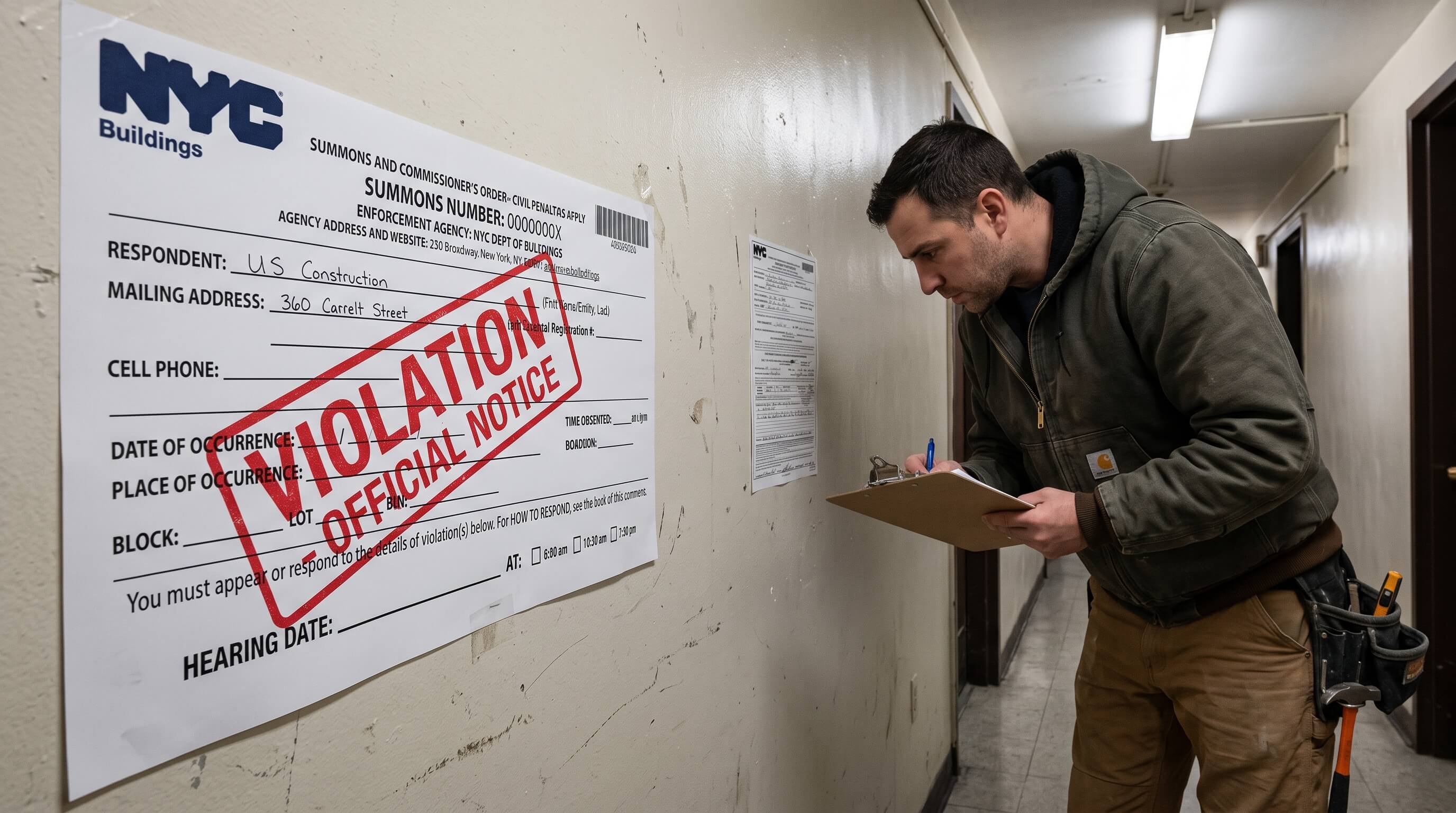
Open violations with the NYC Department of Buildings surface during title searches (condos) or board package reviews (co-ops). Resolving them costs anywhere from $500 to over $100,000. Common issues include unpermitted renovations, expired work permits, and illegal room conversions. Check your property's violation history at the NYC BIS portal before you list. Finding out at closing is the worst possible time.
Even if you didn't cause the violation, you're responsible for clearing it. Budget 2 to 8 weeks to resolve violations, depending on complexity. Some require hiring an architect or expediter to close out permits.
Pied-à-Terre Surcharge
Effective July 1, 2026, NYC now charges an annual surcharge on non-primary-residence condos and co-ops with a DOF market value above $1M. If you're selling a pied-à-terre, you may owe this for the current year. This surcharge also affects your buyer pool — non-primary-residence buyers now face an ongoing annual cost, which could reduce demand and offers for certain properties.
Outstanding Special Assessments
Building capital improvements like a new roof, elevator modernization, or facade work create assessments that unit owners must pay. If there's an ongoing assessment, the board may require you to pay the remaining balance at closing. These can run $5,000 to $50,000 or more. Ask your managing agent about any current or planned assessments before listing.
Title Defects (Condos)
Unpaid liens, judgment liens, or tax liens must all be cleared before closing. Your attorney handles the search and resolution, but the costs come out of your proceeds. Clearing a judgment lien can take weeks and may require negotiating a settlement with the lienholder.
Prorated Costs
Property taxes, maintenance or common charges, and assessments are prorated to the closing date. On a property with $3,000/month in combined charges, closing mid-month means you owe roughly $1,500 at the table.
Net Proceeds: What You'll Actually Take Home
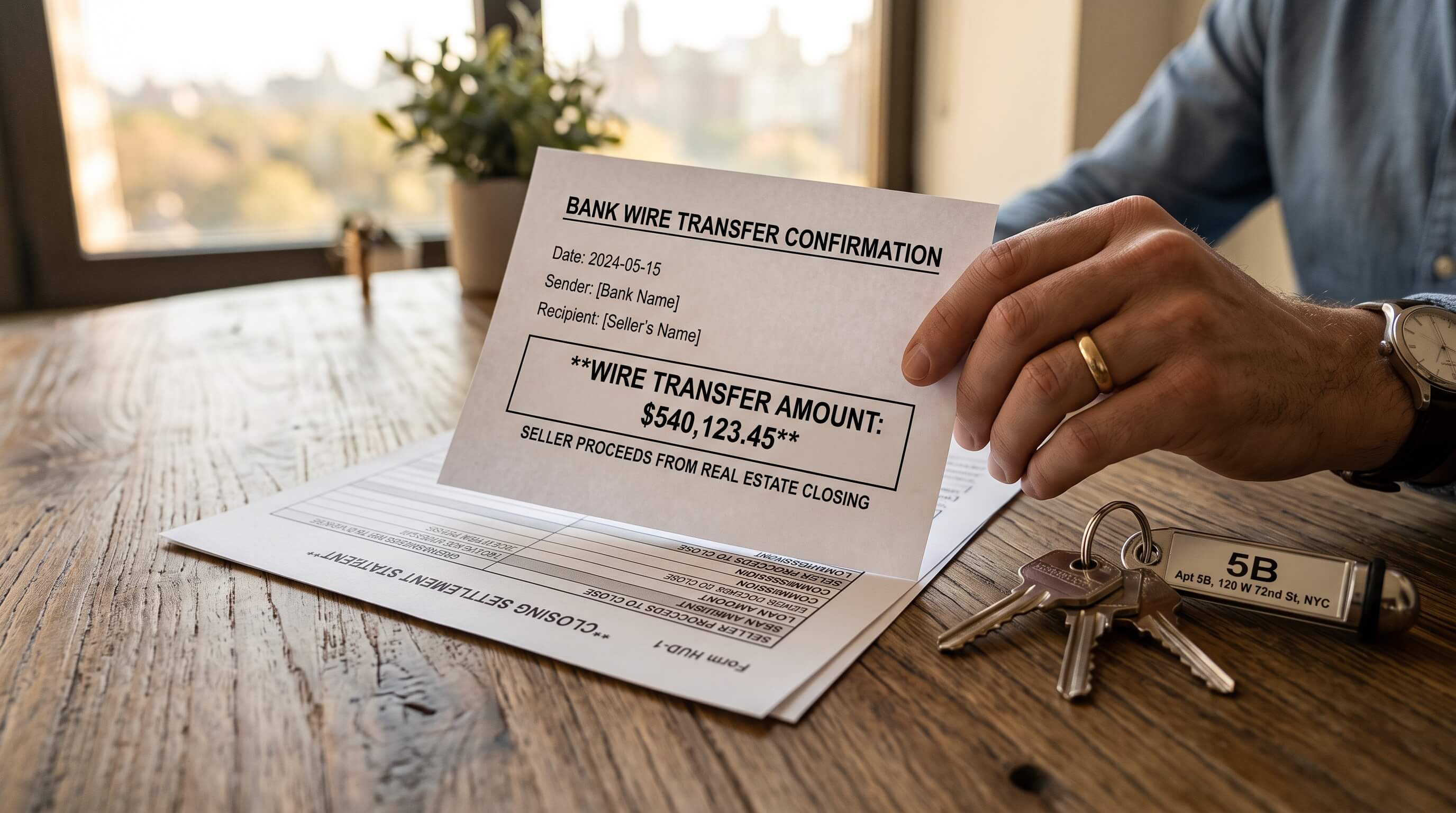
Here's what you'd actually take home at three common NYC price points. These examples assume no capital gains tax owed and no mortgage payoff. Use them as a baseline, then adjust for your situation.
$500K Condo Sale
Net Proceeds: ~$465,200
Note: Pricing at $500,001 instead of $499,999 triggers an extra $2,125 in transfer taxes — you'd actually net less.
$1M Co-op Sale
Net Proceeds: ~$909,250
Note: If this were a condo, total costs would drop to ~$70,750 (7.1%) — the flip tax accounts for the entire difference.
$2M Condo Sale
Net Proceeds: ~$1,869,500
Note: Your buyer pays $20,000 in mansion tax at this price. Pricing at $1.99M could save your buyer $5,000 and attract stronger offers.
A quick formula for estimating your net proceeds: Sale price minus broker commission, minus transfer taxes, minus attorney fees, minus flip tax (co-ops), minus pre-listing costs, minus miscellaneous fees, minus mortgage payoff balance equals your net proceeds before capital gains tax.
Frequently Asked Questions
Who pays closing costs when selling a home in NYC?
The seller pays their own closing costs, including broker commission, transfer taxes, attorney fees, and (for co-ops) flip tax. The buyer has separate costs including mansion tax, mortgage recording tax, and their own attorney fees. In NYC, seller closing costs typically total 8% to 10% of the sale price. Neither side pays the other's costs unless specifically negotiated in the contract.
How much are transfer taxes when selling in NYC?
NYC sellers pay two layers: NYC RPTT (1.0% at or below $500K, 1.425% above) and NYS transfer tax (0.4% below $3M, 0.65% at or above $3M). Combined, you'll pay 1.4% to 2.075% depending on your sale price. On a $1M sale, that's $18,250. Watch the $500K cliff: crossing it by even $1 costs you an extra $2,125 because the higher rate applies to the entire sale price.
What is a flip tax in NYC?
A flip tax is a fee co-op buildings charge when you sell your apartment. It's not a government tax — it's set by your building and goes to the reserve fund. Typical range: 1% to 3% of the sale price. HDFC co-ops can charge 10% to 30%. Check your proprietary lease before listing. Your managing agent can confirm the exact rate and calculation method.
Can I sell my NYC apartment without a broker?
Yes, but FSBO sales are rare in NYC. You'd save the listing agent's ~2% commission but would still typically offer 2% to buyer's agents. Without MLS exposure and StreetEasy placement, you may sell for less or wait significantly longer for a buyer. For most sellers, the 2% listing commission pays for itself through better pricing, faster sales, and professional negotiation.
How long does it take to close on a home sale in NYC?
Condos typically close in 60 to 90 days from accepted offer. Co-ops take 90 to 120+ days because of the board approval process. Add 4 to 8 weeks if using a CEMA. The longer your timeline, the more you pay in carrying costs like mortgage payments, maintenance, and property taxes — roughly $2,000 to $8,000 per month depending on your property.
How much does it cost to sell a co-op in NYC specifically?
Co-op sellers typically pay 9% to 11% of the sale price due to the building flip tax (usually 1% to 3%). On a $1M co-op with a 2% flip tax, total closing costs run roughly $90,750. HDFC co-op sellers face flip taxes of 10% to 30%, which dramatically increases total costs. A $500K HDFC sale with a 20% flip tax would cost $100,000 in flip tax alone.
What is the NYC mansion tax and do sellers pay it?
The mansion tax is paid by the buyer, not the seller, on purchases of $1M or more. Rates range from 1.0% to 3.9% depending on the purchase price. Sellers don't pay it directly, but it affects pricing strategy. Buyers avoid crossing mansion tax thresholds, so pricing just below $1M, $2M, or $3M can widen your buyer pool and generate more competitive offers.
What capital gains taxes will I owe when I sell my NYC home?
If the property was your primary residence for 2 of the last 5 years, you can exclude $250K (single) or $500K (married) of gain. For investment properties or gains above those limits, NYC's combined tax rate can reach 38.6%: federal (20%) + NIIT (3.8%) + NYS (up to 10.9%) + NYC (up to 3.876%). Consult a CPA before closing. Investment property sellers should explore a 1031 exchange to defer capital gains entirely.
What happens to open DOB violations when I sell my apartment?
Open Department of Buildings violations transfer to the new owner at closing, which means buyers will demand you resolve them first. Resolving violations costs $500 to over $100,000 depending on severity. Pull a DOB violation search at the NYC BIS portal before you list so you have time to address issues. Budget 2 to 8 weeks for resolution, and expect to hire an expediter for complex violations.
Is a real estate attorney required when selling a home in NYC?
Yes. New York State requires attorney representation at closing for both buyers and sellers. Budget $2,500 to $4,000 in flat fees for a standard NYC residential sale. Your attorney reviews the contract, handles title issues, coordinates the closing, and prepares transfer tax filings. Get referrals from your broker or recent sellers rather than searching online.